
Garages, shops, patios and plant floors
Epoxy Flooring in Houston, TX
Coatings planned around Gulf humidity, hot tires and slabs that sit on clay, with a moisture test and a written price before any work begins.
- Free on-site estimates across the Houston area
- Moisture testing on the slab before any coating goes down
- Written quotes that spell out the prep and every coat
Floors Built for Houston Heat, Humidity and Clay
Epoxy flooring in Houston, TX is a moisture problem first and a color choice second. Houston Epoxy Flooring Pros coats garages, shops, patios and commercial slabs around the city, and almost every call we make on a job traces back to a few local conditions: long runs of heat, air that rarely dries out, clay ground that shifts, and storms that put water where it was never meant to go. A coating that looks great in a brochure can still peel off a Houston slab within a year if those conditions are ignored. This page explains how we deal with them, what the main systems cost on a national basis, and what to ask any installer before you sign.
Heat and humidity set the schedule
The Houston climate figures on Wikipedia show Bush Intercontinental Airport reaching 90F or more on an average of 106.5 days a year, and average annual relative humidity of 74.7%, with summer mornings above 90%. For an epoxy floor coating, those numbers matter more than any brand on the bucket. Resin reacts to temperature. A hot slab shortens working time, so a crew that mixes too much at once ends up with lap marks and thin patches. Damp air adds a second risk: if the concrete surface sits close to the dew point, a film of moisture can form that nobody sees, and a coat rolled over it may haze, blush or never bond. We take slab temperature, air temperature and humidity readings before mixing, and we size each batch to that day. In summer that often means an early start, and on some floors it means a different product.
What comes up through the slab
Most garage slabs here sit right on the ground, and Wikipedia describes Houston as resting on low-permeability clay-silt prairie soils. Clay holds water. A slab poured over wet clay can push moisture vapor up into a coating from below, and that pressure is a frequent cause of blisters and lifting. The same clay swells when wet and shrinks in drought, and the area has more than 150 known surface faults, so cracked garage slabs are routine. Before we quote a floor we run a moisture test and look at every crack. Hairline cracks and shrinkage cracks get ground out and filled. If a slab reads high, we tell you and price a moisture-mitigating primer into the quote instead of crossing our fingers. If a crack looks active, we write that down too, because no coating can hold a moving slab together.
After a flood or a hurricane
Hurricane Harvey dropped more than 50 inches of rain on parts of Houston in 2017, and Tropical Storm Allison brought up to 40 inches in 2001. Plenty of garages around the city have taken on water at least once. A well-bonded epoxy or polyaspartic floor does not soak up water the way bare concrete does, so storm cleanup is mostly a squeegee and a rinse. What a coating cannot do is make a garage flood-proof, and a slab that sat under water can stay damp inside for a long time. If your garage flooded recently, we test it before coating and may suggest waiting until it dries out. Bring this up early, because it moves the timeline more than anything else.
Hot tires, golf carts and workshops
Garages in this city work hard. Cars come home after an hour on sun-baked pavement, and a hot tire can soften a poorly bonded coating and lift it as the car rolls away, a failure called hot-tire pickup. It usually comes from poor prep or a thin, low-solids product, which is one reason we diamond grind every slab instead of acid etching it. Beyond cars, we coat garages that double as home gyms, woodshops, boat storage and golf cart bays. Tell us how you use yours. A floor that sees jack stands and dropped tools may need more build and a broadcast texture, a gym may need a mat zone planned in, and a boat on a trailer drips water that a textured finish handles better.
Choosing a coating system
We install six kinds of floors, listed below. Solid-color epoxy is the workhorse for garages and shops. A full-broadcast flake floor adds grip and hides dust and small flaws. Polyaspartic coatings cure much faster and hold up to UV, which counts near a west-facing garage door. Metallic epoxy brings a marbled, liquid-looking finish to indoor rooms. Warehouse and plant floors get thicker, chemical-resistant coats, and patios and pool decks get finishes made for sun and bare feet. People often ask what coating is better than epoxy. There is no single answer. Epoxy builds thickness and fills small flaws well, while polyaspartic keeps its color in sunlight and gets a garage back in use in a day or two. On many Houston garages we lay epoxy down first and seal it under polyaspartic. The honest downsides of epoxy alone: it yellows in sunlight, needs several days before you park on it, and fails fast over a damp or poorly prepped slab.
Epoxy flooring cost in Houston
National cost guides make a fair starting point. HomeGuide's national guide prices installed epoxy at $4 to $10 per square foot (roughly $1,600 to $5,800 when the garage holds two cars), with polyaspartic at $5 to $12 per square foot. HomeAdvisor adds contractor minimums of $500 to $1,000 and puts commercial 100% solids systems from $12 per square foot upward. What moves a Houston price within those ranges is mostly prep: stripping old paint or coatings, grinding stained concrete, filling cracks, and adding a moisture-blocking primer where a test calls for it. Flake density, metallic pigment and a polyaspartic topcoat change the total as well. We measure, test, and then put the full figure in writing. That written estimate is your price.
Questions to ask epoxy flooring contractors
There are many epoxy flooring companies and epoxy floor installers in Houston, and their quotes can look alike on paper. These questions sort them out:
- Is the slab moisture-tested before work starts, and what if the reading comes back high?
- How will the concrete be prepared: diamond grinding, shot blasting or an acid etch?
- What product goes into each coat, and how thick is each one?
- Is the topcoat UV-stable, and when can a car go back on the floor?
- How do you treat cracks, control joints and the edge along the walls?
- Is all of that written into the quote?
We answer every one of these on the first visit, before you decide anything.
Deed restrictions and neighborhood rules
Houston is the largest U.S. city without formal zoning, so many neighborhoods rely on deed restrictions instead, and in Kingwood the village community associations control them. A garage floor coating rarely needs approval, but rules on contractor hours, trailers parked on the street or work with the garage door open can still apply. Mention them when you book so our schedule fits inside them.
Why Homeowners Call Houston Epoxy Flooring Pros
A moisture test on every slab
Clay soil and damp air make slab moisture the top cause of failed floors here, so we test before we quote and price any primer the reading calls for.
Ground, not etched
We diamond grind each slab down to sound, open concrete before coating, the surest defense against hot-tire pickup and peeling.
Installs timed to the weather
On install day we take readings of slab temperature, air temperature and humidity, then mix batches sized to those conditions.
One written, itemized price
One itemized quote covers the system, every layer, prep work and total cost, making side-by-side comparison with other bids easy.
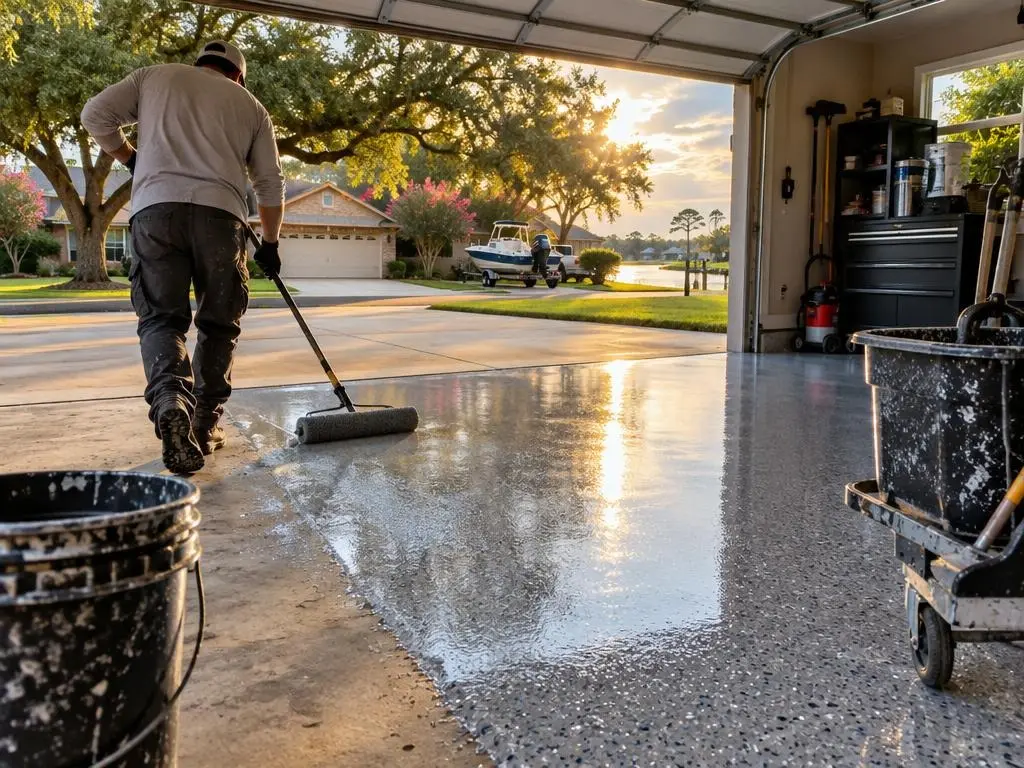
Common Questions
What does an epoxy floor cost in Houston?
For installed epoxy, HomeGuide's national figures come to $4 to $10 a square foot (about $1,600 to $5,800 when the garage fits two cars), with polyaspartic listed at $5 to $12 per square foot. Stripping an old coating, repairing cracks, adding a moisture primer or choosing a decorative finish moves a floor higher in those ranges. Once we have measured and tested the slab, you get the price in writing.
Does epoxy flooring have drawbacks?
Standard epoxy yellows in sunlight, needs several days before it can take a car, and can blister or peel over a damp or poorly prepared slab. In Houston, the moisture risk is the big one. Testing first, diamond grinding and a UV-stable topcoat deal with most of these weak points.
Is there a coating that outperforms epoxy?
For garages that get sun or need a fast return to use, polyaspartic is often the better topcoat because it holds its color and cures within a day or two. Epoxy still builds thickness and fills flaws better at a lower cost per coat. Plenty of floors combine the two, with epoxy underneath and polyaspartic on top.
Which kind of floor works for industrial use?
It depends on the load and the chemicals. Thick 100% solids epoxy is a common choice for warehouses and forklift traffic, with chemical-resistant topcoats where oils, cleaners or solvents spill and added texture where floors get wet. We look at what the floor sees each day before recommending a system.
Can you coat a garage that flooded during a storm?
Usually, once the slab has dried out. Concrete that sat under water can stay damp inside well after the surface looks dry, so we test it first. If it still reads high, we either wait or use a moisture-mitigating primer, and we explain which in the quote.
Will Houston humidity cause problems during the install?
It can if nobody checks. Moisture can condense on a slab that is near the dew point and spoil the bond, so we measure slab temperature and humidity on site and only roll coats when the readings allow. Summer jobs often start early in the day.
When can I drive onto a freshly coated garage floor?
HomeGuide says a polyaspartic floor can handle heavy vehicles after 24 to 48 hours and that epoxy may take up to a week before it is fully cured, and the HomeGuide epoxy guide advises keeping cars off it for 2 to 7 days. When we finish, you get the exact times for the system on your floor.
Do you coat residential garages or only commercial floors?
Both. Most of our work is home garages, patios and pool decks, and we also coat warehouses, shops, service bays and other commercial floors around Houston.
Houston and the Towns Around It
Houston is the center of our service area, and we work across Greater Houston from there. To the north we coat floors in The Woodlands, Spring, Tomball, Magnolia, Conroe, Humble, Kingwood and Atascocita, along with Cypress and Jersey Village to the northwest. Inside the Loop's western edge we cover Spring Valley Village and Hunters Creek Village. To the east and southeast we work in Pasadena, Deer Park, Channelview, La Porte and Baytown along the Ship Channel, and in Clear Lake City, Webster, Seabrook, League City and Friendswood near the bay. Each area brings its own floor questions. Bayou-side neighborhoods such as Jersey Village and Friendswood have flood history to consider, master-planned communities such as The Woodlands have their own approval rules for changes to a lot, bay towns see boats and salt-laden storm water, and the Ship Channel cities have plenty of plant and warehouse floors. Pick your town below for the local details.
- Epoxy Flooring in Houston, TX
- Epoxy Flooring in The Woodlands, TX
- Epoxy Flooring in Spring, TX
- Epoxy Flooring in Humble, TX
- Epoxy Flooring in Kingwood, TX
- Epoxy Flooring in Atascocita, TX
- Epoxy Flooring in Cypress, TX
- Epoxy Flooring in Tomball, TX
- Epoxy Flooring in Pasadena, TX
- Epoxy Flooring in Baytown, TX
- Epoxy Flooring in League City, TX
- Epoxy Flooring in Friendswood, TX
- Epoxy Flooring in Webster, TX
- Epoxy Flooring in Seabrook, TX
- Epoxy Flooring in La Porte, TX
- Epoxy Flooring in Deer Park, TX
- Epoxy Flooring in Conroe, TX
- Epoxy Flooring in Jersey Village, TX
- Epoxy Flooring in Channelview, TX
- Epoxy Flooring in Magnolia, TX
- Epoxy Flooring in Spring Valley Village, TX
- Epoxy Flooring in Hunters Creek Village, TX
- Epoxy Flooring in Clear Lake City, TX
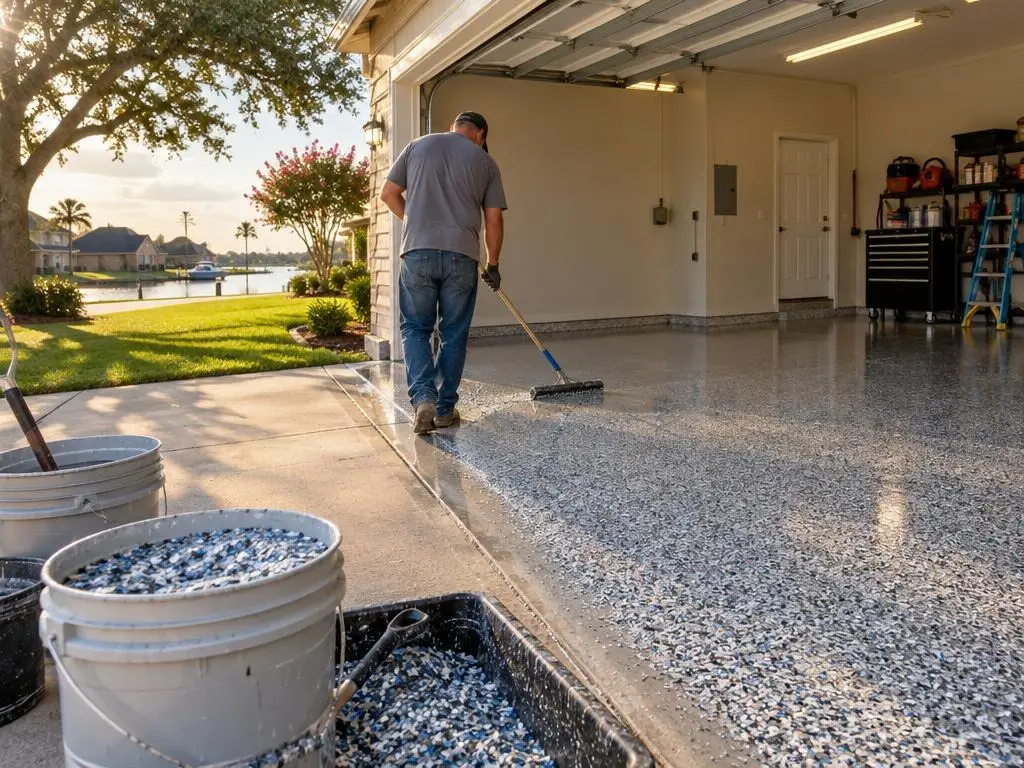
Our Epoxy Flooring Services
Six coating systems for the concrete Houston households and businesses actually use: hard-working garages, indoor rooms, plant floors and sun-baked pool decks.
Epoxy Garage Floors
Diamond-ground, crack-repaired garage floors with a topcoat chosen for Houston heat, hot tires and the sun through the door.
Learn more →Full-Broadcast Flake Floors
Vinyl chips scattered wall to wall over the wet base coat, giving a textured floor that hides dust, grit and small slab flaws.
Learn more →Polyaspartic Floor Coatings
Quick-curing, UV-stable coatings that often return a garage to use in a day or two while holding their color in the sun.
Learn more →Metallic Epoxy Flooring
Poured, marbled epoxy floors with metallic pigment for indoor rooms, bars, offices and retail spaces.
Learn more →Warehouse & Industrial Epoxy
Thick, chemical-resistant concrete floor coatings for warehouses, plants, shops and service bays, phased to keep you running.
Learn more →Patio & Pool Deck Coatings
Pool deck resurfacing and patio coatings built for Houston sun, bare feet, pool chemicals and storm runoff.
Learn more →Schedule Your Free Houston Floor Estimate
We will measure, check the slab's moisture level and leave a written price with you.